
Every week a buyer sends us the same comparison: two hair removal consoles, one advertising five diode bars, one advertising sixteen. The question attached is always about bar count. The question that actually decides the treatment is never on that spec sheet. It is what happens after the bars, at the fiber, where all of those watts get funneled into a strand of glass thinner than a toothpick.
We manufacture the fiber side of that chain. So let us walk the whole path, from diode bar to tissue, and see where the marketing numbers and the physical numbers part ways.
What a fiber coupled diode laser bar actually is
Start with the source. A diode bar is a semiconductor chip, a centimeter wide, that emits a thin fan of light from its edge. One bar produces tens of watts. Stack the bars vertically with cooling between them and you get the modules that power most 808 nm hair removal consoles. Real listings on the market today cover the whole spectrum: five bars at 100 W each for 500 W, ten bars at 60 W for 600 W, sixteen bars at 50 W for 800 W.
A fiber coupled diode laser bar system takes that stacked output and does something deliberate with it: an array of micro lenses gathers the fan-shaped beams from every bar and focuses them into a single-core multimode fiber. The light travels down the fiber to a handpiece that contains no laser parts at all. That is the architecture behind the “fiber laser” hair removal machines flooding listings this year, and its selling points are real ones: the handpiece drops in weight because the bars moved into the console, the drop-a-handpiece failure mode that costs clinics thousands disappears, and the diodes live in a properly cooled chassis instead of a hot handset.
Here is the first naming trap, though. The listings call it everything: fiber laser diode bar, diode stack, fiber-coupled module, bars-in-machine system. They all describe the same three-part chain, bar to coupling optics to fiber. And the one component that actually touches the patient is the last part, the fiber, which almost never appears in the spec table with its core diameter or numerical aperture. Keep that omission in mind. It matters later.
The number of diode bars is a proxy. What is it proxy for?
To be fair to the bar counters: in fiber coupled diode laser hair removal, the number of diode bars is the cleanest shorthand for total optical output, and total output buys session speed. More watts through the same spot size means higher fluence per pulse or faster rep rates, and a full-body session at 10 Hz beats one at 2 Hz for salon throughput. Five hundred watts was the standard a few years ago; six and eight hundred are the marketing floor now.
But bar count is a proxy for three different things that only loosely travel together: output power, thermal load, and lifetime. Sixty watts per bar pushed through ten bars runs cooler and lasts longer per bar than one hundred watts squeezed from five. Power conversion efficiency in published stack data runs around 45 to 55 percent, which means the other half of your wall power becomes heat that the water chiller must swallow. A console with more bars, driven gently, can outlive a console with fewer bars driven hard. The spec sheet lists bars and watts. It does not list how hard the design leans on either.
Laser diode bar fiber coupling: where the watts leak
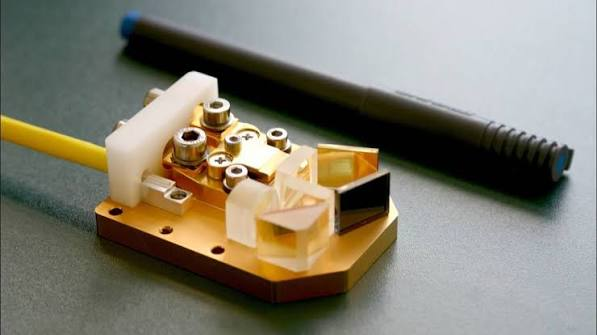
Coupling is the quiet step that decides how many of those advertised watts survive the journey. Each bar emits a beam that diverges fast in one axis and slow in the other, and micro lenses must square that fan against the fiber’s acceptance cone, set by its numerical aperture. Do it well and most of the bar output enters the core. Do it cheaply and watts land on the cladding instead, where they heat glass instead of tissue.
Nobody publishes coupling efficiency on a hair removal listing, which is a shame, because it is the difference between “600 W on the label” and maybe 400 W at the fiber exit. The same logic continues downstream, at the other end of the fiber. A poor cleave, a scratched window, a core diameter mismatch between what the console expects and what is installed, every one of those subtracts from the number the sales page printed. This is why a bare fiber laser system should be bought as a matched pair with the console it serves, and why we measure transmission on every fiber instead of sampling a batch.
From fiber to skin: the only numbers the patient feels
At the handpiece the beam exits into a spot, commonly around 13 by 13 millimeters in hair removal work. Area: about 1.7 cm². Now the console numbers finally become tissue numbers. A fluence setting of 20 J/cm² means roughly 34 joules delivered per pulse through that spot. Whether those 34 joules arrive comfortably or painfully depends on how long the pulse lasts, which is the fluence-versus-power-density distinction: same dose, different rate, different heat diffusion, different patient experience.
Notice what never entered this calculation. Bar count. The bars set what is possible, the coupling optics set what survives, and the fiber and spot size set what the follicle receives. A buyer optimizing on the first number while ignoring the last two is tuning the part of the system that touches nobody.
So how many bars should you ask for?
The honest answer: as many as your throughput requires, driven as gently as the budget allows, with the fiber treated as the spec item it actually is. When evaluating a fiber-coupled console, the question list we would bring to the table looks like this:
- Core diameter and numerical aperture of the delivery fiber, not just “handpiece included”
- Measured output at the handpiece, not rated output at the stack
- Watts per bar and how hard the design runs them, which predicts lifetime better than the shots-count sticker
- Replacement fiber availability and its measured transmission, per unit, with batch data
That last line is our home ground. The fibers we build terminate in the same connector family as the consoles above, from 200 micron hair removal work through every core size in between, and each one ships with measured numbers because the arithmetic at the tissue only works with honest inputs. If you are speccing a system end to end, the OEM partnerships page shows how we match fiber to source, and the quote request page is where the bar count stops being a mystery number.
Bars make watts. The fiber decides where they land. Spec both, and the comparison table in your inbox starts telling the truth.