
Every sterile pack on the tray arrives with paperwork, and one document in that stack is never read at the moment it was written for. The instructions for use come folded into the pouch, printed in four or five languages, and they leave with the packaging. By the time the fiber is connected and the aiming beam is on, the only paper in the room that was written specifically for that thirty seconds is in the bin.
That habit is rational and badly calibrated. Most of an IFU genuinely is not for the person holding the device — it is for the reprocessing department, the buyer, the biomedical engineer and the regulatory file. A small part of it is for nobody else, and that part is not optional in the way the rest is.
An IFU is a list of what the manufacturer could not design away
Start with the order in which a manufacturer is required to solve a problem.
EU MDR Annex I §4 sets out three risk control options, and it requires them in a specified order of priority: eliminate or reduce risks as far as possible through safe design and manufacture; where appropriate take adequate protection measures, including alarms; and only then provide information for safety — warnings, precautions and contraindications — and, where appropriate, training. EN ISO 14971:2019+A11:2021 puts the same three options in the same sequence in clause 7.1, and is explicit that the order is mandatory rather than preferential. Annex Z of that standard exists precisely to map the sequencing onto the MDR.
The practical meaning is blunt. Information for safety is the weakest of the three controls. It is the tier you fall back to when the first two are not technically feasible, and safety engineering treats it as weak for a reason that has nothing to do with the quality of the writing: a control that has to be read, understood, remembered and acted on under time pressure is a control that fails exactly when it is needed.
So the warnings section is not a legal appendix bolted onto the front of a user guide. It is an inventory of hazards that survived the design process. That gives a reading order which is the opposite of the one the document is bound in: read the warnings first. In about ninety seconds it tells you what this device was not designed to protect you from, which is more useful than the preceding eight pages telling you what it does.
The IFU is the only document that describes a pair, not a part
Here is the second thing the document does that nothing else in the room does.
A datasheet describes one object: this fiber, with this core, this numerical aperture, this maximum power. A quotation describes a price. Marketing describes a benefit. Only the IFU is required to describe a combination, because Annex I §23.4(q) obliges it to identify the other devices or equipment the device is intended to be used with in order to obtain a safe combination, and to state any known restrictions on combinations.
That is why the compatibility figures live in the IFU and not in the fiber’s own documentation. The IFU is the document that defines the pair. Which changes what “compatible” means at the tray: a connector that screws onto the console has demonstrated that it fits, and nothing more.
the safe-combination line
Somewhere in the operating section there is a sentence, or a small table, that names the console, the wavelength window and the maximum power. Three values, and the requirement is that they match together, not individually.
The three fail in different ways, which is why they need checking as a set. A connector that seats correctly but was never validated against that console is an alignment problem waiting to happen. A fiber whose window is correct but whose power ceiling is below the setting produces a hot end face rather than an error message. A power ceiling that matches but a window that does not is a fiber that will transmit the energy and absorb some of it along the way.
Two habits worth building. First, treat the maximum power as a value that belongs to a specific fiber and its build, not to a core diameter — it is stated per product, and the same nominal core can carry different ceilings in different constructions; the bare fiber specification shows the shape of that, listing geometry, connector options, NA variants and length as separate items that each constrain the others. Second, do this check against the console’s own manual rather than from memory, because the pairing is defined in two documents and only one of them is on the tray.
what the single-use statement actually says
Most people read the crossed-out “2” as a rule. It is more interesting than that.
Annex I §23.4(p) requires that where a device bears a single-use indication, the IFU must state the known characteristics and technical factors that could pose a risk if the device were reused — and it requires that this information be based on a specific section of the manufacturer’s risk management documentation. Read that requirement again, because it is unusual. The IFU is not merely permitted to say “do not reuse”. It is obliged to tell you what would go wrong if you did, and the source of that statement is a defined part of the risk file.
So the single-use paragraph is checkable. It should name a mechanism, not repeat a prohibition. If it names one, you now know what you are protecting against and you can sanity-check it against what you know of the device. If it is a bare instruction with no mechanism, you have found something worth asking the supplier about.
The same section handles the reusable case from the other direction. For a device supplied as reusable, §23.4(n) requires instructions for the validated reprocessing process and information identifying when the device should no longer be reused — signs of material degradation, or the maximum number of allowable reuses. Note the shape of that: reuse for a properly reusable device is not an open-ended judgment, it is a bounded number or a stated end-of-life criterion. Where no such number exists, the device was not designed or validated as reusable, which is the honest explanation for why so many clinical consumables are supplied the other way. On a delivery fiber the distinction is per item rather than per family: the bare fiber listing separates connector, geometry, numerical aperture and length as independently selectable properties, and whether a given item is supplied for single use or as a validated reusable version is one more property to confirm rather than infer.
the one preparation step that is not allowed to be skipped
Annex I §23.4(i) requires details of any preparatory treatment or handling before the device is ready for use — sterilization, final assembly, calibration, disinfection — and §23.4(k) requires the information needed to verify that the device is properly installed and ready to perform safely and as intended.
Every device has one step in that set that carries the most weight, and it differs by device, so no general rule saves you the reading. What can be generalized is the shape of it: it is always a step that produces a state you could otherwise assume you already had. A fiber whose face has been inspected is not the same object as one that came out of a pouch looking clean; a connector seated to the interlock release is not a connector that feels tight.
The four device-specific steps for a delivery fiber under a first case — pouch, compatibility, connection, aiming-beam check — are laid out in the first-case checklist in this section, and the reason to read the IFU’s version anyway is that yours will have one step the generic sequence does not. On a bare fiber, where the end face arrives plane-polished and with no buffer over it, that step is usually the one about the face. The IFU is where the manufacturer names the step that its own validation depended on.
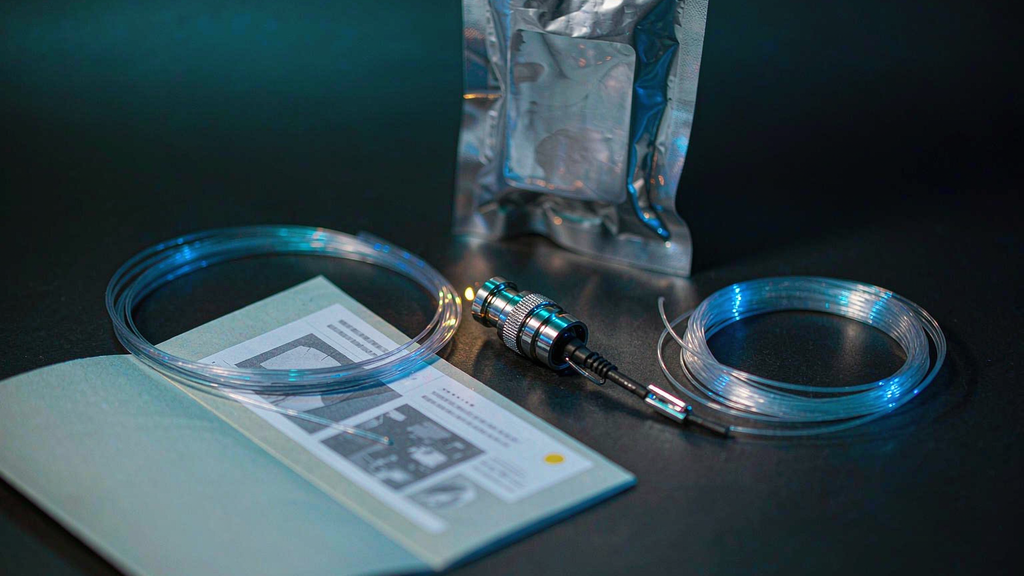
the sentence about a pouch that is already open
Annex I §23.4(l) requires that a device supplied sterile carry instructions for what to do in the event of the sterile packaging being damaged or unintentionally opened before use. There is a matching obligation on the other side of the barrier: §23.3(j) requires the sterile packaging itself to carry an instruction to consult the IFU for exactly that situation.
That is a closed loop, and it is the only one on the tray. The pouch points at the IFU; the IFU is required to have the answer; the answer is not a judgment call you are expected to improvise. Where the practical decision in this article is easiest to get wrong is not diagnosis but impulse — a small tear looks survivable, the case is running, and the answer is three paragraphs away in a document that has already gone in the bin.
One more thing in the same neighbourhood. The pouch, and therefore the IFU it points to, is where the traceability fields live: the batch or lot number and the expiry, the UDI carrier where the regulation requires one, and — required by §23.4 — the date of issue or revision number of the IFU itself. Two of those fields are worth writing into the case record before the case starts: the lot, and the IFU revision. The lot tells you what you used. The revision tells you what you knew.
The blue circle that means the warning is the control
There is a visual marker worth knowing about, because it inverts the logic above in a way that is genuinely useful.
EN ISO 20417:2021 — the standard that replaced EN 1041 as the reference for information supplied by the manufacturer, and which covers accessories expressly as well as devices — requires that where reading the instructions for use is the primary risk control measure, a mandatory-action safety sign be placed accordingly (ISO 7010-M002, the blue circular “refer to instruction manual” symbol).
Follow that through. The hierarchy says information is the last resort; the symbol says that here, information is the control — there is no design measure behind it and no alarm that fires if you get it wrong. So the blue circle is not decoration. It flags the passages where the manufacturer’s own analysis concluded that your reading them was the whole of the protection. If you are going to read one thing and skim the rest, read that.
Your copy may be the wrong revision
This part has changed recently, and it changes what “reading the IFU” means in practice.
Commission Implementing Regulation (EU) 2025/1234, adopted on 25 June 2025 and in force since 16 July 2025, removed the list of eligible device categories from the electronic-IFU rules and extended electronic instructions to all medical devices and accessories intended for professional users, including Annex XVI products. It also repealed the old Regulation (EU) 207/2012 — which, as a footnote, MDR Annex I §23.1(f) still cross-refers to, a textual residue that has not been tidied up. The Commission’s own consultation, run in late 2024, reported that 87% of the healthcare professionals who responded preferred electronic instructions.
Several consequences land on the tray.
- The label has to tell you that the instructions are supplied electronically, and describe how to reach them. A label that says nothing about it, on a professional-use device, is a label worth a second look.
- A paper copy is available on request, free of charge, within seven calendar days. For a department that wants a controlled paper copy in the tray rather than an app, that is a route, not a favour.
- The web address for the electronic instructions is registered in the Eudamed UDI database once UDI registration is mandatory, which means the authoritative current version is reachable from a device identifier rather than from a photocopy.
- Previous versions must remain available, which is what makes revision comparison possible at all.
- Emergency and start-up information must still be provided physically, on the device or its accompanying material — the electronic route is not permitted to hide the part you need in the first minute.
Which produces one habit. Stop treating the printed sheet as the document; treat it as a snapshot, note its revision number, and pull the current file from the manufacturer’s documentation hub when the snapshot and the device in your hand look like different vintages. A specification revised twice since the leaflet was printed is not a mismatch anyone will flag for you.
What you can hand off, and what you cannot
The useful thing about knowing the required content list is being able to divide it.
Annex I §23.4 asks for eighteen lettered items. Four are the ones above. Several more belong to other people in a well-run department: reprocessing and sterilization-revalidation instructions to whoever owns decontamination; materials and substance declarations, including CMR and endocrine-disrupting substances above the threshold, to procurement; disposal to facilities; electromagnetic and software information to the biomedical engineer; and the technical description to the service organization. There is no professional gain in a surgeon reading a phthalate declaration.
What does not delegate is the part that changes what the operator does with their hands. Four items, one page, and a revision check each time the device changes. That is a smaller reading task than the document’s size suggests — and more useful than the four-second version, which is to look for a symbol on the pouch and get on with the case.
This is an operating and documentation note, not clinical advice. Follow the instructions for use supplied with the device you are using, and your institution’s own laser safety program.