
Open a case of holmium fibers from two suppliers and you may find three different connectors inside it, all of them labeled for the same laser console. An SMA-905 sits next to an FC/PC, and the catalog entry you were sent lists ST as well. It is natural to read that as a menu: pick the best one. That reading is wrong, and it is worth saying so in the first paragraph, because the three names do not come from three competing attempts to solve the same problem.
They come from three different industries, three different decades and, most importantly, three different definitions of what a good connection is. Until you separate those, the comparison has no answer. Once you do, the picture becomes almost embarrassingly simple: in medical laser delivery, one of the three has won nearly every socket, and the two losers are still around for reasons that have nothing to do with which one is optically superior.
The three names come from three families
SMA stands for SubMiniature version A, and it started life as a radio-frequency coaxial connector, not an optical one. The design was later adapted to fiber, and it carried its ancestry with it: a machined metal body, a screw coupling, and a size class that has nothing to do with light. The “905” designator belongs to that electrical lineage and refers to one particular body size in the family — the sibling SMA-906 is essentially the same interface with a longer ferrule protrusion, which is why the two appear interchangeably in some datasheets.
FC stands for Ferrule Connector. It was developed for telecommunications, uses a threaded coupling nut, and pairs a 2.5 mm ceramic ferrule with a key, so the fiber can only seat in one rotational position. The key is not decoration. It is what makes repeatable physical contact possible, and repeatable physical contact is what keeps back-reflection low. FC is standardised in IEC 61754-13, and in telecom it survives today mostly on test equipment and instrument ports, where repeatability after re-mating matters more than how fast you can plug something in.
ST stands for Straight Tip, also known as BFOC. It was developed for multimode local-area networks at a time when LANs were the volume application, and it uses a quarter-turn bayonet lock — push in, twist, done. It is standardised in IEC 61754-2. The other member of that telecom family, SC, is standardised in IEC 61754-4 with a push-pull housing, and LC in IEC 61754-20 with a 1.25 mm ferrule. All three of those telecom connectors share a 2.5 mm ceramic ferrule (LC excepted) and differ mainly in coupling mechanism and housing.
So line them up correctly: FC and ST are two telecom answers to the question how do we get two single-mode fibers to touch repeatably at low reflection, and SMA-905 is a high-power answer to the question how do we get a lot of watts from a large-core fiber into a metal box without anything catching fire. Those are not the same question, which is why comparing their insertion-loss numbers and declaring a winner is a category error. Insertion loss in telecom is measured on a 9 µm core under physical contact. Medical delivery runs 200 to 1000 µm cores, often with a deliberate air gap. The numbers are not portable between the two worlds, and any table that puts them in the same column should be read with suspicion.
What medical lasers actually chose, and the four reasons why
Look at the fibers themselves and the pattern is monotone. Across a full medical delivery line — bare fiber, holmium, radial, side-firing, diffuser, lipolysis, hemorrhoid, and the focusing handpieces that take the same interface — SMA-905 is the standard termination on essentially every product. Our own bare fiber page lists it as the default and names FC/PC, ST and Luer Lock as OEM options rather than alternatives. That distribution is not a stylistic preference. It follows from four requirements, and if you read the list carefully you will notice that not one of them is an optical specification.
| Requirement | Why SMA-905 satisfies it | FC/PC | ST |
| Survive the power | Metal ferrule, large bore, rated into the hundreds of watts in high-power variants | Low to medium power class | Low power class |
| Get rid of the heat | All-metal body and ferrule act as a heat sink; the ferrule itself is part of the thermal path | Ceramic ferrule, low thermal conductivity | Ceramic ferrule, often plastic housing |
| Be connected by hand, in a room, without tools | Screw nut, finger-tight, no keying step to get wrong | Threaded, slow to mate (tens of seconds) | Fast to mate, but the bayonet can back off |
| Be sterilised | Stainless or beryllium-copper construction; autoclave-capable variants are standard in this class | Not designed around autoclave cycling | Not designed around autoclave cycling |
The ferrule geometry tells the same story. SMA-905’s ferrule is roughly 3.175 mm in outer diameter, noticeably larger than the 2.5 mm ferrule of FC and ST, and the bore can be made from 125 µm up to 2500 µm to accept the core sizes medical delivery actually uses. Some high-power variants are also explicitly built without adhesive at the fiber front — the industry term is epoxy-free or air-gap ferrule technology — precisely so that there is no organic material sitting near a facet that will be hit by stray light.
And here is the part that vendors rarely volunteer when they are selling you the “best” connector: SMA-905 has no key. The ferrule can be rotated freely inside the coupling, so rotational alignment is not repeatable, and the insertion loss and return loss are both worse than what FC delivers. Published comparison tables that score SMA-905 at the top for power handling and ruggedness put FC/PC and ST/SC two or three stars below — and the same tables say plainly that SMA-905 is not recommended for single-mode fiber because alignment repeatability is poor at small core diameters.
That sentence is the whole argument of this article in one line. Medical lasers did not choose SMA-905 despite it being a mechanically-minded, optically indifferent interface. They chose it because of what that trade buys. On a 200 µm core, an alignment error of a few micrometers costs a fraction of a decibel. On a 9 µm core, it costs you the link. The connector is not better or worse; it is optimized against a different objective, and medical delivery optimizes for watts, heat and hands.
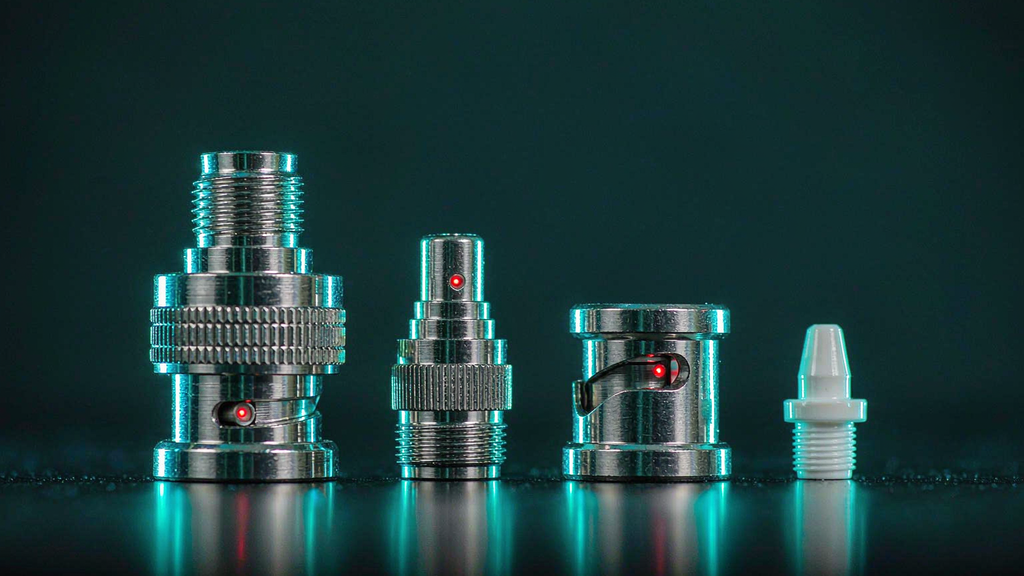
The air gap: not a defect, a different objective function
The clearest place to see that different objective is the deliberate air gap, and to understand why it exists you have to know what telecom was doing at the same time, because telecom spent roughly three decades eliminating exactly this feature.
| Generation | End-face practice | Typical insertion loss | Typical return loss |
| NC (non-contact, unkeyed) | Flat polish, gap between faces to avoid rotational scratching | ≥ 0.5 dB | about −20 dB |
| PC (physical contact) | Flat polish plus keying, faces pressed together | about 0.3 dB | −30 to −40 dB |
| Domed PC | Convex polish guarantees core-to-core contact | < 0.3 dB | −40 dB or better |
| APC (8° angle) | Reflection steered into the cladding | — | better than −60 dB |
The driver is stated plainly in the standard literature: each air gap costs roughly 5 %, or about 0.25 dB, in reflection loss, and that reflected light travels back up the fiber. Worse, the same literature notes that single-mode systems are extremely sensitive to reflections — which is the real reason the PC-domed-APC progression happened. It was not driven by multimode, large-core, high-power delivery. It was driven by telecom’s intolerance of back-reflection at small cores.
Medical high-power fiber runs the trade in the opposite direction. It keeps the air gap, accepting the loss, because of what an air gap buys: a fiber facet with nothing in front of it but air — no epoxy, no coating, no connector material in the path of scattered light. High-power reference material is blunt about the alternative. Under high power, adhesives degrade and outgas, and the failure does not stop at the adhesive: it starts a chain in which absorbed light raises local temperature, which increases absorption, which raises temperature again, until the facet is destroyed and the connector with it. An air gap keeps the fiber tip suspended so that the fiber can be coupled at high power without damaging the connector. The same specifications add that the metallic hardware provides rapid heat conduction — the ferrule doubles as a heat sink.
The evidence for this being a deliberate engineered feature, rather than an accident of cheap assembly, is visible in the way high-power parts are specified. Third-party high-power SMA-905 families distinguish between two build variants of the same connector: an HPSMA905 in which the fiber tip is left suspended in the ferrule and the end face is uncoated, and a standard SMA-905 in which the fiber tip is bonded into the ferrule bore over roughly 1.5 mm of engagement. Same interface, same thread, different decision about what is allowed to touch the glass.
That distinction matters because it resolves the most common confusion in this whole subject. The air gap is a statement about the front of the ferrule — the region ahead of the fiber facet stays free of adhesive. It is not a statement that the fiber is unsupported. The rear of the ferrule is still a bonded joint; the fiber is still epoxied into the bore, just further back. So when a product page says “air gap” and a service page says fibers are “bonded and polished,” those two sentences are describing two segments of the same ferrule, not disagreeing with each other. Writing this correctly is the difference between understanding the design and repeating a slogan about it.