
The labels differ because they have to
Start with the paperwork, and skip the price column for a moment.
Under MDR Annex I, a device label has to carry an unambiguous indication of the time limit for safe use, expressed at least in year and month — or, where there is no such indication, the date of manufacture instead. Those two are alternatives, not companions. The pouch carries the first. The bulk carton carries the second, and it has no expiry field because the fiber inside does not expire; the pouch does.
The same section then applies a second set of particulars, and these must appear on the sterile packaging itself rather than only on the outer carton: an indication that the item is sterile packaging, a declaration of sterile condition, the sterilization method, the manufacturer’s name and address, a description of the device, the month and year of manufacture, the same safe-use limit, and an instruction to check the instructions for use for what to do if that packaging is damaged or opened before use.
| Label field (MDR Annex I, Section 23) | Sterile-packed | Non-sterile bulk |
| Sterile state and sterilization method | On the sterile packaging itself | Does not apply |
| Safe-use time limit (year-month) | Required | Not applicable — nothing expires |
| Date of manufacture | Month and year, on the sterile packaging | Required in place of the time limit |
| Lot number | Required | Required |
| Instructions if packaging is damaged or opened | Required on the pouch | Not applicable |
The consequence is mundane and expensive. The two cartons cannot share a label template, a receiving checklist, or a barcode routine built around an expiry field. One of them has to be rotated by expiry; the other only by lot age. Rolling a single stock rule over both is how a warehouse ends up scrapping pouches that nobody opened — the sterile line ages toward a date, the bulk line does not age at all in the same sense, and the system treating them alike will be wrong about one of them every single quarter.
What the sterile side actually buys you is six millimeters of seal
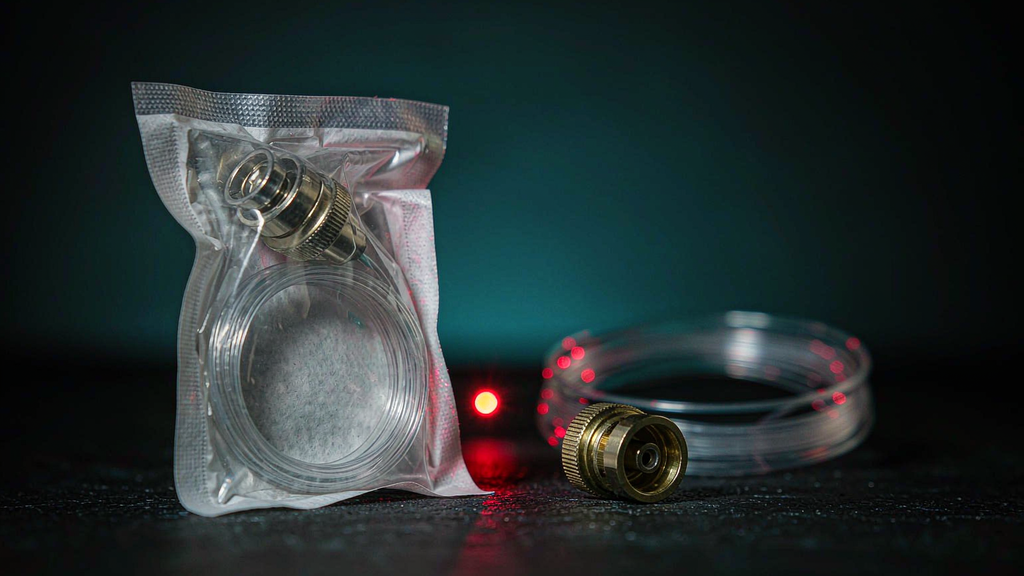
ISO 11607-1 draws a line that matters here. A sterile barrier system is the minimum packaging that keeps microorganisms out; protective packaging is whatever else exists to keep that barrier intact. The pouch around a single-use fiber is the sterile barrier system. Its paper side is porous on purpose — sterilant has to get in and out, or nothing works — which leaves exactly one thing standing between the room and the device: the heat-sealed line around the film.
EN 868-5 sets a floor under that line. Overall seal width is at least 6 mm, or the ribs sum to at least 6 mm; the film has to be free of pinholes by construction; seal strength has to hold before and after sterilization, with a lower floor for non-steam processes than for steam. Pouch geometry is also constrained so the thing can be opened properly: a thumb notch or a lip, and a marked peel direction that disturbs the least fiber, so a scrub nurse can present the fiber into the field without the paper shedding into it.
Two consequences rarely make it into a purchasing comparison.
The first: the pouch is a user interface. ISO 11607-1 requires the sterile barrier system to be openable by the intended user without compromising sterility, which makes peel behavior a requirement rather than a nicety. A pouch that opens with a fiber tear is a failed system even if every seal test passed on the line.
The second: seals usually fail for a boring reason — something sharp inside the pouch. The fused tip of a radial fiber, the knurled body of a connector, a stiff coil pressing against the film under stacking load during distribution simulation. The device damages its own package. That is why tip guards and coil restraints exist at all, and why “the pouch just needs to be large enough” is a habit worth breaking before your first pallet, not after.
The date on the pouch is bought in chamber days
A shelf-life claim is not a field someone types. ISO 11607-1 expects stability testing to show the sterile barrier system still holds over time, and it accepts accelerated aging as sufficient evidence for a claimed expiry date until real-time data are available — with real-time samples required to run to the claimed shelf life anyway, in parallel, to completion.
The arithmetic behind that is worth carrying. ASTM F1980 uses a conservative Q10 of 2, meaning the aging rate roughly doubles for every 10 °C. Running at 55 °C against a 23 °C ambient gives about a ninefold acceleration, so one year of claimed shelf life costs roughly 40 days of chamber occupancy — and it buys nothing permanent, because the real-time samples are sitting in a stability room for the full period regardless.
Put that on your own numbers. Ordering steps in this market are typically 50–100 pieces for a first sterile carton and 500 upward for production, with a 5,000-piece lot at the top end (our ordering FAQ spells out the same tiers). Take that 5,000-piece lot with a three-year claim: to consume it before it expires you need to use about 139 fibers a month, every month, starting the week it lands. Every pouch that misses that pace was sterilized, sealed, inspected, chamber-aged and shipped at full cost, and then thrown away unopened. At that point the volume discount on a sterile SKU is partly a bet on your own case volume.
The bulk carton has no such clock. Name what it lacks: the fiber does not expire. Only the pouch does — and only because the pouch is the thing carrying the sterility claim. A bare fiber shipped in a bag has no date to manage, which sounds like an advantage right up to the moment you notice the same carton has also transferred the paperwork.
The bulk carton does not remove the cost, it moves it into your building
A sterile carton arrives with the sterility chain already finished: bioburden controlled, dose or cycle validated, residuals tested, aging studied, seals inspected on a sample, lot documented. A bulk carton arrives with all of that unstarted, and the buyer picks it up whether or not they have a bench for it.
Public industry ranges — all of which move with product family, site and method — put terminal sterilization validation in the six-figure range over six to twelve months: ethylene oxide validation programs commonly land between $80,000 and $220,000 all-in, annual re-qualification in the $10,000–30,000 band, bioburden monitoring a few thousand per product per year, and EO residual testing per ISO 10993-7 in a similar range. Cycle pricing is the visible part and the least decisive: published comparisons put a pallet of EO sterilization on the order of $150–500 against $110–150 for gamma, and those figures vary enough between sources that any single number quoted to you is a starting point, not a specification.
The number that decides this is not the cycle price. It is whether adding your fiber to an existing validated load triggers validation work — and for a coiled 3 m device with a polymer jacket, a sealed pouch and a fused radial tip, it usually triggers something.
Method is not a free choice either, and not one to make on price. Steam is out for a packaged fiber: the pouch and the fiber’s own jacket are polymer systems, and 134 °C is aimed at instruments. Radiation is efficient and leaves no residue, but it is hard on polypropylene, where published work shows chain-scission embrittlement and mechanical loss that can appear during storage well after the cycle — which is precisely why radiation-tolerant formulations exist. EO runs cold, reaches most materials, and costs you long cycles plus aeration, a regulated residual profile (≤4 mg per device for limited exposure, averaging ≤2 mg/day for prolonged exposure), and a capacity question: several facilities have closed or cut output under emission rules and community pressure, which is why sterilizer slots, not fiber production, are sometimes the real lead time on a bulk order.
Which method a given fiber is compatible with is set by its most sensitive material — jacket, connector epoxy, pouch film — and not by the invoice anyone would prefer to receive.
Two cartons, two receiving routines
This is where the comparison stops being about money. A sterile carton is received by inspecting the barrier: seal width and continuity across a sample, pouch integrity, label and expiry fields, and the lot’s sterilization documentation. There is no incoming bioburden of your own to check, because you did not sterilize anything. A bulk carton is received the other way round: the pouch-side checklist is meaningless, and what matters is the cleanliness and integrity of the parts plus the bioburden figure you will need if you intend to sterilize them yourself — because a validated dose or cycle is validated against an assumed bioburden, and a supply change that raises it without telling you invalidates that assumption silently.
The point-by-point routine belongs on its own page, and it is written up in our seven-point incoming inspection. Read the two together rather than instead of each other; the seal-inspection arithmetic there is the natural continuation of this one. The documentation set we ship with each lot is also worth pulling before you write a PO, because most of the mismatch between the two cartons shows up as a missing document rather than a missing part.
Where the carton actually flips
Write the decision as three gates, not a price comparison.
1. Is there a validated sterilization process inside your building, and will it accept this device? If not, there is no volume at which bulk wins. The bulk carton is cheaper at the dock and more expensive in total, because the chain has to be built or bought. If yes, bulk wins until per-unit handling and label control exceed the amortized cost of a cycle slot — which for most buyers with an in-house process is a wide margin.
2. Can you consume a sterile lot inside its shelf life? Take the smallest lot you would actually order, divide it by the months of claim, and compare against your honest monthly consumption. If the answer comes out below your real rate, you are planning a scrap line. The alternatives are a smaller sterile lot or re-examining the single-use decision at the per-case level, where the denominator is a document rather than a guess.
3. Does the fiber need to be sterile on arrival? Inside a sterile field, yes, and the pouch is the mechanism — that is what you are paying for. If the fiber is a component that goes into your own sterile pack, or if it is used in a setting where the sterility of the fiber is not the critical item, then the pouch is selling you handling convenience and an expiry liability in the same transaction.
The mistake worth avoiding is treating this as a packaging upgrade. The pouch is not a better version of the bag. It is a different product: a different label, a date that cannot be edited, chamber time behind that date, and a receiving routine of its own. The structure of the whole comparison section is the same for every one of these choices — what changes is which column carries the cost.