
Three tracks, not one
The instinct is to file this under “labeling exercise, with a couple of engineering questions attached.” It is three projects sharing a calendar.
| Track | The question it answers | Who signs it off |
| Identity and label | Whose name sits in the manufacturer field — and what that makes you | Your regulatory lead, with your supplier’s |
| UDI and registration | Who assigns the UDI-DI, and who registers the device | Your regulatory lead |
| First article and packaging | Is the printed pouch, the printed ferrule and the finished tip still the device your clinicians already use | Both engineering teams |
Only the third track resembles the project people picture when they say “put our logo on it.” The first two decide the date.
The first decision is identity, and there are two doors
A dental diode brand that puts fiber tips on the market under its own trade name is, in most cases, making itself the manufacturer of those tips. That follows from the definition of a manufacturer in Article 2(30) of the MDR: the entity that markets a device under its own name or trade mark is the manufacturer regardless of who actually built it. Most brands walk through this door without noticing they picked it, because it is the door that makes the brand mean anything at all. Its cost is a full manufacturer’s file: technical documentation, clinical evaluation, a quality management system, post-market surveillance, and a person responsible for regulatory compliance at the organization’s disposal under Article 15.
The second door is Article 16(1)(a). You market under your own brand, an agreement exists with the supplier, and the label continues to identify the original manufacturer as the manufacturer. Under that arrangement the private-label brand does not take on manufacturer obligations. What it also does not get is the thing most brands assume comes bundled with private label — it does not get to be the entity the regulation treats as responsible, and as the next section shows, it does not get to own the UDI either.
Neither door is wrong, and this article is not going to tell you which one your business is standing in. Whether your specific change to the label falls inside Article 16(2)(a) as the provision of further information necessary to market the device in a member state, or crosses into becoming a manufacturer, is a question for your own regulatory team. What belongs on your project plan is that the two routes are not two versions of one schedule. One of them adds a technical documentation and clinical evaluation project on top of the work below; the other adds a statutory notice period instead. The framework here is description of the terrain, not advice on where to stand.
One framing helps while you are deciding. A private-label consumable is not a product you buy; it is a supply slot inside someone else’s device, and a slot has to fit a console, a tray and a registration file that all already exist. That is the same framing the OEM partnerships page uses for the six forms such a slot can take, and it is the reason the identity question is answered before the drawing question rather than alongside it.
The UDI decision has to be made in week one
Until mid-2026 you could find two opposite answers to a simple question: when a device is sold under a brand name while the label still names the original maker, who obtains the UDI-DI? The Medical Device Coordination Group closed that gap in MDCG 2026-5, a position paper published on 22 July 2026. Distributors and brand owners had been requesting their own UDI-DIs from EU issuing entities in their own name, reading Article 16(1)(a) as permission to do so. The MDCG’s answer is that this is not consistent with the regulation. The manufacturer indicated on the label is the only entity that can assign UDI-DIs to the device and the only entity that can register it in EUDAMED.
Two consequences land directly on a private-label timeline.
First, two UDI-DIs are fine; two owners are not. Where the same physical device is marketed under two trade names — the supplier’s own brand and yours — different UDI-DIs are appropriate. Both must be assigned by the manufacturer and both must sit under the same Basic UDI-DI in EUDAMED. Practically, that means your artwork cannot wait on your own registration, because you are not the party who can perform it. The practical work can be delegated to you under an agreement; the liability cannot.
Second, the carrier is printed. A UDI carrier sits on the pouch and, depending on the configuration, on the piece itself. Artwork that goes to print before the UDI-DI is allotted prints the wrong carrier, and that is not a revision — it is a reprint and, for a sterile item, a fresh packaging lot. This is why the UDI sits in week one next to the drawing freeze rather than in the week before the first shipment. The same week is when you want your customization scope settled in writing, because core diameter, length, connector, end-face finish, jacket and labeling are all decided in that one document, and every later change to it re-opens the print.
Four of the eight weeks are a legal clock
Article 16(4) of the MDR sets a deadline that has no engineering equivalent: at least 28 days before making a relabeled or repackaged device available, the operator carrying out that activity must inform both the manufacturer and the competent authority of the member state where the device is to be marketed, and must submit a Notified Body certificate attesting that its quality management system meets the requirements of Article 16(3). MDCG 2021-26 confirms the reading and adds the detail that the competent authority may request a sample or a mock-up of the relabeled or repackaged device, including the translated label and IFU.
Read that clause again, because the natural assumption is the wrong one. The 28 days is not a waiting period that starts once the paperwork is finished. The certificate has to exist inside the same 28 days. A project that treats the notice as a formality to be filed in the last week has not shortened the clock; it has moved the last week to the front of next quarter.
There is one piece of relief in the same guidance: MDCG 2021-26 states the notification is due when a device is relabeled or repackaged for the first time for a given member state — it does not have to be repeated unit by unit or batch by batch. A second lot under the same brand, the same member state and the same information does not restart the four weeks. That is the argument for doing the packaging and labeling work once, properly, with every language version you expect to need, rather than adding markets one carton at a time. The quantity ladder behind that first carton is on the FAQ page, and it matters here for a scheduling reason rather than a purchasing one: how much you commit to on the first run decides how many times the artwork can be revised before the revision lands on the clinical supply.
| Week | What the project is waiting on | What runs alongside |
| 1 | Signature on the identity route; UDI-DI ownership confirmed; drawing frozen | Artwork layouts begin from the frozen drawing |
| 1-4 | The 28-day notice window, with the Notified Body certificate attached inside it and a mock-up on file | Sample build, first article, print proofs |
| 3-4 | Pouch print proof and IFU language set under the brand’s document control | Ferrule marking check, tip color assignment |
| 5-6 | Sterile first run; barcode and UDI carrier verified against the production print | Lot format freeze |
| 7 | First article accepted against the frozen drawing | Release documentation assembled |
| 8 | First sterile carton released | — |
The other four weeks are artwork, IFU and first article
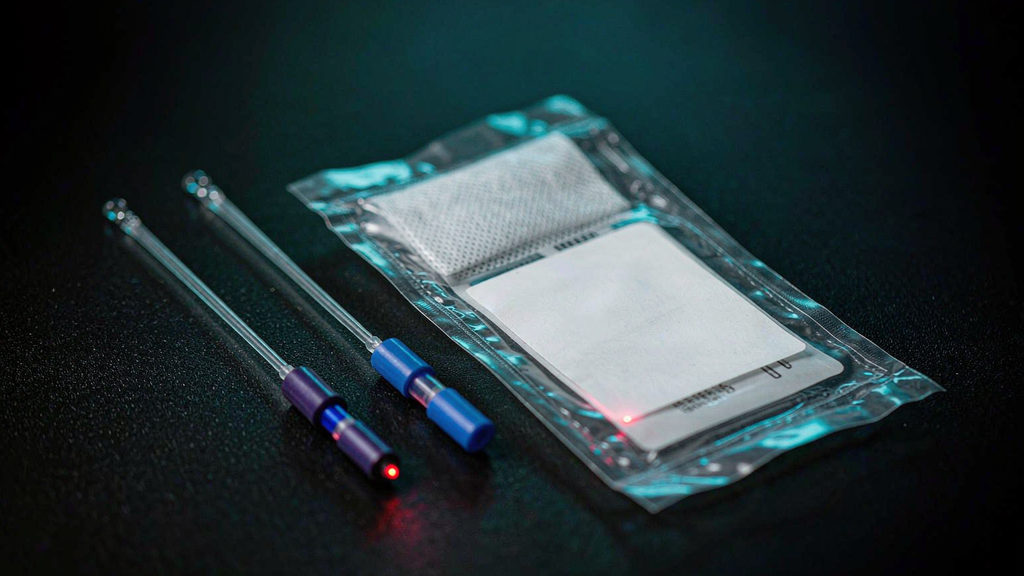
This is where the onsite facts are worth stating plainly, because they are the ones a buyer can check. A catalog-connector sample carrying your logo on a stock pouch runs 2–3 weeks after the drawing freeze. A custom ferrule protrusion, a private-label IFU and sterile validation each add time on top of that, which is why the eight-week figure is a project length and not a sample lead time. The first sterile carton is usually 50–100 pieces, and its purpose is not supply — it is to freeze the pouch artwork and the lot format before a production quantity is committed. A print proof is exchanged before the first sterile run, and an NDA typically precedes the artwork exchange itself.
The IFU is the step that gets underestimated most often. In a private-label arrangement the IFU stops being a document you receive and becomes a document you control: language set per member state you ship into, your document number, your revision history, your approval signature. That is a document control task inside your own quality system, not a translation purchase, and it is usually the item that decides whether the print proof is a one-pass event. The second underrated item is the ferrule print, because it is checked on a physical proof on a small curved metal surface rather than on a screen. The third is the tip itself: in the color-coded disposable tip range the color is not decoration, it is a reorder key that practices have memorized by procedure and length, so a private-label run has to reproduce the existing mapping or teach a new one.
Three places this project slips
Artwork started before the identity decision. Design time spent before you know whose name goes in the manufacturer field is time you will spend twice. It looks like a week saved; it behaves like two weeks lost, and the loss is discovered at the print proof, which is the most expensive place to discover anything.
The notice filed after the artwork is released instead of with a mock-up. The guidance allows a mock-up, and the mock-up can carry a label that is not yet final. Filing in week 1 with a mock-up starts the 28 days immediately; filing in week 3 with a released artwork ends the project in week 11 however fast the factory runs. This is the single largest scheduling decision in the whole project and it happens in the first week.
The IFU language set chosen at the print proof. Every language added after the proof restarts a document control cycle. Choosing the set at the same meeting as the identity decision costs one agenda item; choosing it later costs a week per language, and that week is not compressible by anyone.
If we ran it again
The arithmetic explains the eight weeks better than any process description. Twenty-eight days of notice, plus two to three weeks for a sample built after the drawing freeze, plus about a week for the print proof and the first sterile carton. Serialize those and you get 28 + 21 + 7 = 56 days — exactly eight weeks, with no slack in it whatsoever.
Which means eight weeks is not a speed claim. It is the length of the critical path when the statutory clock is the longest single item on it. The only lever that shortens it is overlap: the sample build and the first article ride inside the notice window, the UDI decision is made before the drawing freezes instead of after, and the IFU language set is fixed in the same meeting as the identity decision instead of at the print proof. The one item that cannot be overlapped with anything is the 28 days itself — so the honest way to read a private-label schedule is to count the statutory weeks first and then see how much engineering fits inside them.
If you want to see how the three tracks map onto a supply slot before the first call, the OEM partnerships page sets out the six delivery forms a program can take, from fiber sub-assemblies through sterile single-pack and IFU under your brand. The sample ladder and the print-proof sequence sit in the FAQ, and the drawings and spec files themselves are in Downloads. None of that shortens the statutory notice period — but it decides whether the other four weeks are four weeks or eight.
This article describes a regulatory framework and a project timeline. It is not legal advice, and the identity question must be settled with your own regulatory team.