
Two colorectal units buy the same 1470 nm diode laser. Both set it to 10 W. Both use a radial fiber, both curette the tract first, both close the internal opening with an absorbable suture. One unit’s patients heal; the other unit keeps seeing discharge at six weeks. Nothing on the console explains the difference. What explains it is how fast the fiber came out of the tract — because in fistula laser closure, the dose is set by the operator’s hand, and the console is only supplying the wattage.
FiLaC — fistula laser closure — has grown from an eleven-patient pilot in 2011 to a technique covered by a 24-study meta-analysis of more than 1,500 patients. The numbers are now good enough to describe honestly: real healing rates, a real recurrence problem, and a continence record that no other sphincter-sparing procedure matches. This piece walks through the dosing math, the published protocols, the tract geometry that decides outcomes before the laser fires, and what all of it means when you have to specify the fiber.
What FiLaC actually does inside the tract
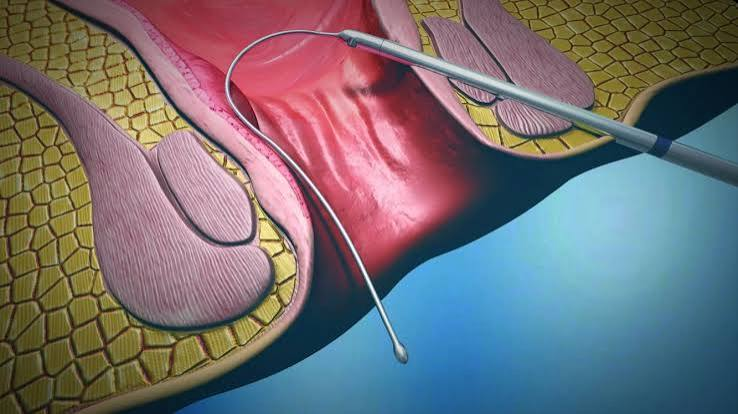
The target is not the sphincter and not the tissue around the tract — it is the tract epithelium itself. Chronic fistula tracts are lined with epithelium, and as long as that lining survives, the tract behaves like a drain: secreted, open, self-maintaining. FiLaC destroys the lining with heat and forces the tract to behave like a wound instead — collapse, fibrose, close.
A radially emitting fiber is inserted through the external opening and advanced to the internal opening, then withdrawn while emitting 360° around the full circumference. The thermal effect strips the epithelial lining, contracts collagen in the tract wall, and triggers fibrotic sealing. The surrounding sphincter muscle stays cold, which is the entire point of the technique.
The wavelength that made this controllable is 1470 nm. Wilhelm, who published the first pilot series in 2011, chose it deliberately for its absorption profile in water: penetration is limited to roughly 2–3 mm, so the thermal injury stops at the tract wall instead of cooking outward into the sphincter (Wilhelm, Int J Colorectal Dis 2013). Earlier diode work in veins had shown what 980 nm does when penetration runs deep — vessel wall injury beyond the target — and the fistula application inherited that lesson.
The dosing knob is your hand, not the console
The energy the tract wall receives per centimeter is not a console setting. It is arithmetic between two numbers, one of which lives on the machine and one of which lives in the operator’s wrist:
Dose (J/cm) = Power (W) ÷ withdrawal speed (cm/s)
Run the identity against real protocols and it holds every time. The Oxford group’s implementation series withdrew at 1 mm/s with a 10 W setting — 10 J per mm, 100 J per cm, stated as a machine number but produced by the hand (Wien Klin Wochenschr, 2026). A trial protocol currently combining FiLaC with platelet-rich growth factor specifies a 1000 µm radial probe at 12 W, 1 mm/s — which is 120 J/cm written as a speed (PLASMA study, ClinicalTrials.gov NCT07810075). The original Wilhelm pilot pulled at 3 seconds per centimeter with 13 W, which the same arithmetic converts to about 39 J/cm.
The practical consequence is uncomfortable and useful: two surgeons who both say “10 watts” can be delivering 40 or 100 J/cm depending entirely on pullback discipline. A wattage without a withdrawal speed is not a protocol. It is half of one.
What the published protocols actually delivered
| Series | Wavelength | Power | Withdrawal |
| Wilhelm pilot (n=11) | 1470 nm | 13 W | 3 s/cm |
| Giamundo (n=35) | 980/1470 nm | — | — |
| Three-year retrospective (n=138 FiLaC) | 1470 nm | 10 W | 1 mm/s |
| Oxford implementation (n=56) | 1470 nm | 10 W | 1 mm/s, pause every 100 J |
| PLASMA trial protocol | 1470 nm | 12 W | 1 mm/s continuous |
A review pooling the dosing literature puts the delivered energy anywhere from 30 to 120 J/cm across studies, with the better healing numbers clustering at 100–120 J/cm (Dogma-versus-Evidence review, 2025). The Oxford team added one refinement worth stealing: pausing briefly after every 100 J to let the heat dissipate, specifically to reduce postoperative pain without reducing the dose.
Is more energy better? Yes — and no
The dose–outcome relationship in FiLaC is real but not clean. Higher energy improves sealing, and the review data point that way. Yet the highest success rate in the table above belongs to the lowest dose: Wilhelm’s eleven patients, treated at roughly 39 J/cm, healed at 81.8% — a figure most 100 J/cm series never reach.
The honest reading is that energy is necessary but never sufficient. Wilhelm’s cohort was tiny, selected, and treated with seton drainage first plus a formal advancement flap at the internal opening. The three-year retrospective, which treated 138 patients without a seton stage, reached 73.9% at the higher dose. Between those lines sit the variables the laser cannot see: tract diameter, side branches, the quality of the curettage, and whether the internal opening was properly closed. Giamundo’s series made the same point from the other direction — patients who had prior seton placement did better, because the seton had already narrowed and fibrosed the tract before the laser arrived (Giamundo et al., Dis Colon Rectum 2014). One surgeon in the retrospective described the tactile tell directly: the sticky sensation on retraction that signals the wall is sealing. That feedback — not the console display — is what tells you the dose is landing.
Tract geometry decides before the laser fires
The most consistent finding across FiLaC literature has nothing to do with laser settings. It is the tract itself.
- Width. Tracts wider than roughly 4–8 mm heal worse. A radial probe emitting into a wide-open lumen is heating air and granulation as much as wall; the epithelium at the perimeter never reaches sealing temperature. Wide tracts need more aggressive curettage or complete shrinkage before energy is applied — Doganci’s work made full tract shrinkage a prerequisite rather than a hope.
- Length. The tract has to be long enough for a meaningful withdrawal. Very short tracts are explicitly a limitation — the review literature calls tract length the Achilles heel of the technique, and the Oxford series excluded them.
- Side branches. The technique is blind to secondary tracts. Missed internal openings, missed side tracts and inadequate drainage are the three classic causes of fistula recurrence (Mitalas et al.) — none of them is a laser problem, and no dose fixes them.
- Sepsis. An undrained abscess is a contraindication, full stop. The standard sequence is drainage and seton first, laser second, once inflammation has settled.
This is why the seton question matters more than the wattage question. A seton stage costs weeks and a second anesthetic, but it standardizes the geometry the laser will meet — narrowed, drained, fibrosed — and the comparative data favor it.
Why 1470 nm won the wavelength argument in proctology
Diode lasers in this space come in 980 and 1470 nm, and both work through the same machine. The reason 1470 became the fistula standard is penetration control: water absorbs 1470 nm strongly, so energy converts to heat within 2–3 mm and stops. At 980 nm, absorption is weaker and the thermal footprint runs deeper than the tract wall — useful where you want bulk coagulation, wasteful and riskier where the target is a thin epithelial lining centimeters away from the anal sphincter.
Giamundo’s series compared both wavelengths within the same fistula protocol and reported better sealing and less thermal damage at 1470 nm. The same physics that made 1470 nm the EVLA standard applies here, which is why the chromophore-matching logic we set out in the wavelength selection guide reads almost the same for a vein and a fistula tract: match the wavelength to the depth of the target, then let the fiber geometry do the rest.
Choosing the fiber: geometry, marking and how it enters the tract
FiLaC hardware requirements are specific, and they explain why a dedicated radial probe exists at all rather than reusing a hemorrhoid or vein fiber:
- 360° radial emission is the technique. A bare tip deposits energy forward and char-dependent; in a narrow tubular tract that concentrates heat at one wall point and risks perforation. The radial probe wraps the emission around the full circumference so the whole lining is treated in one pass. Our radial fiber is built exactly for this — 400/800 µm and 600/950 µm unmarked, 400/730 µm and 600/750 µm ring-marked, all with SMA 905 connectors and >90% transmission.
- Ring marking is the depth gauge. Once the fiber is inside the tract, the surgeon is working blind. A marked ring at the distal glass section gives a visual reference for how deep the emitting zone sits and how far the withdrawal has progressed — the same logic we described for hemorrhoid work in the radial versus conical tip comparison, transplanted to a tubular tract.
- Core diameter follows the tract. Most proctology work runs on 600 µm cores with 950 µm cladding; the 400 µm variants exist for narrow or tortuous tracts where a stiff 950 µm assembly will not pass. What matters as much as the core is the assembly’s ability to track a curve — the tip geometry guide covers how distal shape changes the passage behavior.
- The handpiece decides the entry angle. Our proctology handpieces — the L5-G950 with a 100 mm cannula and the L5-GD with a 50 mm cannula — pair with 400–600 µm fibers for stable perianal insertion and a fixed protrusion, which is worth having when the emitting zone needs to start exactly at the internal opening. The dedicated proctology fiber line (600/950 µm, ring-marked, glass OD 1.5 mm, compatible with 980 and 1470 nm diodes) shares this platform.
- There is a bare-fiber variant. Laser fistulotomy — opening the tract rather than closing it — uses a bare fiber along the cut line, and the three-year retrospective ran its 18 fistulotomy patients this way inside the same 1470 nm system. Units offering both procedures keep a bare fiber in the drawer for exactly that.
The honest scorecard
FiLaC marketing usually leads with the continence data and buries the healing data. Both belong in the same table. The two most recent syntheses — a single-arm meta-analysis of 24 studies and 1,503 patients (Duda et al., Int J Colorectal Dis 2025) and a network meta-analysis of 49 articles and 3,520 patients across four sphincter-sparing techniques (Techniques in Coloproctology 2025) — let us place FiLaC against its actual competitors:
| Technique | Failure rate | Worsening continence | Minor complications |
| FiLaC | 43.9% | 0 reported | 10.2% |
| VAAFT | 22.3% | 0 reported | 7.2% |
| LIFT | 28.6% | 1.5% | 4.3% |
| Endoanal flap | 25.9% | 7.3% | 6.2% |
Read straight, FiLaC has the highest failure rate of the four and the best functional safety. The pooled single-arm numbers agree: 57.5% primary healing, 18.5% recurrence, and new-onset incontinence in 0.57% — with a reoperation rate of 36.5% that reflects how often failures get treated again rather than left alone (Duda et al., 2025).
What the continence column actually buys is a property no other column captures: failure without cost. When a flap fails, the patient has lost tissue and sometimes continence. When LIFT fails, there is a healed scar bed complicating the next attempt. When FiLaC fails, the sphincter is intact and the tract can be lasered again, flapped, or lifted — the technique consumes none of the patient’s reserves. For the patients who need that property most — women with anterior fistulas, elderly patients, anyone with borderline continence, high transsphincteric tracts where cutting is not an option — a 57% first-pass cure with a free retry is a defensible trade. For a simple low tract, fistulotomy still cures more patients in one sitting, and pretending otherwise would be selling.
Where FiLaC fits in the decision tree
The review consensus is stable: sepsis first (drain, seton), anatomy second, and FiLaC where sphincter preservation outranks single-shot cure rate. Contraindications are equally settled — undrained collections, tracts too short to withdraw through, and active uncontrolled Crohn’s disease. Within those boundaries, the technique’s short learning curve and 25-minute average operative time are why it keeps spreading even among units that also run LIFT.
Specifying a fistula fiber for your laser system
If you build or distribute diode laser systems for proctology, the fistula fiber is the specification exercise where small decisions show up in outcomes:
- Emission geometry and dosing are linked. Every J/cm number in the tables above was produced by a 360° radial probe. A fiber that emits differently voids the published dosing — there is no “FiLaC-compatible” bare tip.
- Ring marking earns its place here. Depth control inside a blind tract is a functional requirement, not a cosmetic option. Our ring-marked radial variants put the mark on the distal glass so the withdrawal is readable.
- Assembly stiffness has to survive the curve. A 950 µm cladding assembly tracks a transsphincteric tract differently than a 730 µm one. Offering both 400-series and 600-series cores lets the surgeon match the fiber to the tract instead of forcing the tract to match the fiber.
- Sterile single-use packaging fits the case mix. Fistula work is contamination-prone by definition; EO-sterilized single packs with lot traceability remove a reprocessing variable from an already variable procedure. Our proctology line ships both ways for units running reusable protocols.
- OEM geometry is on the table. Some FiLaC systems run 1000 µm radial probes. Core diameter, glass length, ring position and connector are all specifiable — tell us the tract profile your system targets and we will match the fiber to it through our OEM program.
The full proctology range, including the handpieces and the application overview, is collected on our Laser Proctology page. For hemorrhoid dosing — the other half of the laser proctology caseload — see the LHP energy dosing guide.
Frequently asked questions
How many joules per cm for fistula laser closure?
The published range runs 30–120 J/cm, with the better healing rates at 100–120 J/cm. The common implementation is 10–12 W at 1 mm/s withdrawal, which produces 100–120 J/cm. Pause briefly after every 100 J to limit postoperative pain.
Why not just run more watts to be safe?
Because the dose is set by withdrawal speed, not wattage — and because overshoot at 1470 nm shows up as pain and delayed healing in a structure sitting centimeters from the sphincter. The tract wall needs sealing temperature, not more temperature.
Does the seton stage really matter?
The comparative data say yes: series that drained and setoned first report better healing, and the mechanism is mechanical — a narrowed, fibrosed, clean tract presents a geometry the laser can actually seal. Skipping the seton stage to save weeks is how the three-year retrospective lost points against the pilot series.
What fiber diameter fits a fistula tract?
600/950 µm assemblies handle most transsphincteric tracts; 400-series cores are for narrow or tortuous anatomy. The fiber should pass without force — if you are pushing, the geometry discussion happens before the laser discussion.
Can FiLaC be repeated after a failure?
Yes, and that is one of its main arguments. Because the sphincter is untouched, a failed laser closure leaves the option set open — repeat FiLaC, LIFT, or flap. The 36.5% reoperation rate in the pooled data is largely this pathway working as intended.
Clinical note: this article summarizes published technique descriptions and outcomes for educational purposes. Treatment decisions belong to the operating surgeon and the patient in front of them.