
The quotation for original tips arrives with the rest of the consumables order, and it is always the line that gets read twice. Thirty initiated tips for an Epic-class console, thirty more for the Woodpecker units in the hygiene rooms, and the practice manager starts doing the yearly arithmetic. Third-party tips exist, usually at a fraction of the price. The hesitation is not really about price. It is about one sentence: “will it actually fit my handpiece?”
That question has a boring, factual answer. Fit is decided by connector geometry, cutting quality is decided by core diameter and exposed length, and both are measurable before a single tip ships. This post is the checklist we run through with clinics before they switch.
Woodpecker laser tips: the color-coded hub system
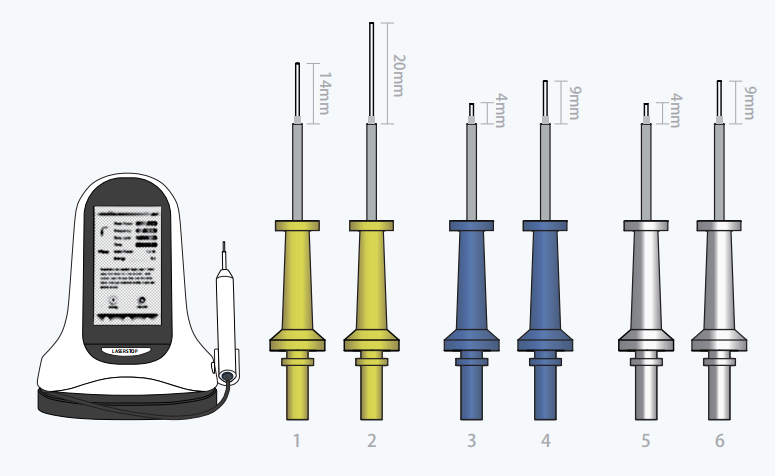
Clinics running Woodpecker laser tips already know the identification system: the hub color tells you the core diameter at a glance. A matching disposable tip needs three things to be compatible. The taper of the hub has to seat in the handpiece without play. The locking depth has to match, or the fiber sits too deep and fires into the cannula. And the exposed fiber length has to match what the clinical presets assume, because a preset written for a 4 mm exposed tip assumes the glass ends where the manufacturer intended.
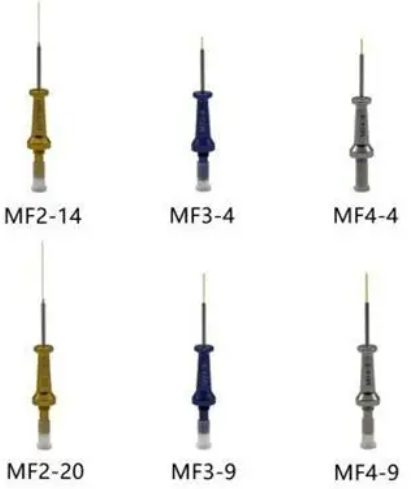
Our MF series covers this family in six models, and the full set is two diameters by three lengths:
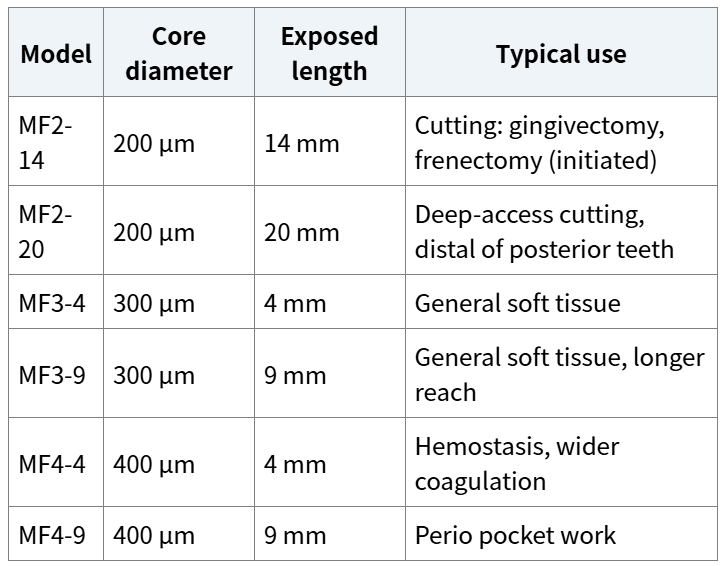
The dose arithmetic behind the diameter column is worth restating, because it is the reason diameter is not a detail. The same 1.5 watts exits a 200 µm core at roughly 4,800 W/cm² and a 400 µm core at roughly 1,200 W/cm². Same console setting, four times the irradiance. If a supplier sends you a “200 micron” tip that is actually 250, your initiated cutting preset behaves like a different machine, and nothing on the console will tell you why.
SOGA laser tips: the second hub family
Practices on SOGA laser tips use a different handpiece interface, and it is the reason a tip that seats perfectly in one console wobbles in another. Our TP series matches this family in five models: TP2-14 and TP2-20 in 200 µm, TP4-4, TP4-7 and TP4-9 in 400 µm, with exposed lengths from 4 to 20 mm. Same glass, same diameter tolerances, a different hub geometry.
Two systems, one factory. That sentence is the actual proposition here: the melt, the draw and the cleave process is identical across both families, and only the connector tooling changes.
BIOLASE tips: what the official guide says, and what matches it
BIOLASE tips for the Epic and ezlase families follow a published size guide, straight from the manufacturer’s IFU: 200 µm tips in 4, 14 and 20 mm, 300 µm tips in 4, 7 and 9 mm, and 400 µm tips in 4, 7 and 9 mm, with surgical, perio and endo labels attached to the lengths. The endo work runs on the long 200 µm tips, perio on the mid lengths, cutting on the short ones.
That guide is exactly why a compatible line is possible to build honestly. The sizes are public, so a replacement tip either matches a published diameter-and-length combination or it does not. Our TP series already covers the 200 µm 14 and 20 mm endo pair and the 400 µm 4, 7 and 9 mm set; the 300 µm lengths are in the MF line at 4 and 9 mm. Pre-initiated versions are a coating question, not a glass question, and they ship on request.
One console-specific note: on the Epic Pro system, 200 µm tips are not offered by the original manufacturer at all, so those consoles live on the 300 and 400 µm sizes. Check which console your practice actually runs before ordering a mixed box.
The compatibility checklist, in order
Before any replacement tip goes into a sterilization pouch, four checks settle the question:
1. Seat test: the hub locks into the handpiece with no wobble and no over-travel.
2. Length check: exposed fiber measured against the published length, not eyeballed.
3. Fire test: one initiation cycle and a burn pattern on paper, compared against a known tip.
4. Batch check: the next box behaves like the first box, which is a manufacturing property, not a clinical one.
Checks one to three are what a careful clinic does on arrival. Check four is what separates a factory from a repackager, and it is the one you cannot verify in the operatory. It is also the reason we publish core tolerance and batch data instead of power posters: the bare fiber line these tips are drawn from holds 200 through 1000 µm in low-OH silica, and the dental tip range carries the same tolerances into the finished hub.
If you want a fit confirmed before ordering, the fastest route is the one clinics already use: send us the console model, or one original tip, and we return the matching spec sheet with the measured dimensions before anything ships. The door for that is our quote page.